Showing posts with label books. Show all posts

Saturday, September 13, 2025

From Writing to Storytelling: How One Group Found Their Voice

I’ve been doing a lot of research on intergenerational literacy and oral history and researching ideas like Gentelligence and exploring how different generations communicate, preserve stories, and pass on traditions lately. Along the way, memories of my own experiences keep bubbling up, reminding me why understanding intergenerational literacy and keeping storytelling alive is so important.

One memory in particular that came back to me was from about a year ago. It was a difficult time for me because my writing group that I had been hosting at the library for several years fell apart. I was saddened by the ending of this group because it had been so magical. Well, in true Compassionate Librarian form, I wanted to keep the magic going, so I found myself starting something new: a storytelling circle. I am someone who loves stories. I am surrounded by books all day, every day, I find myself drawn to stories in every form. 

So I leaned into what I know best: talking to groups and sharing stories.
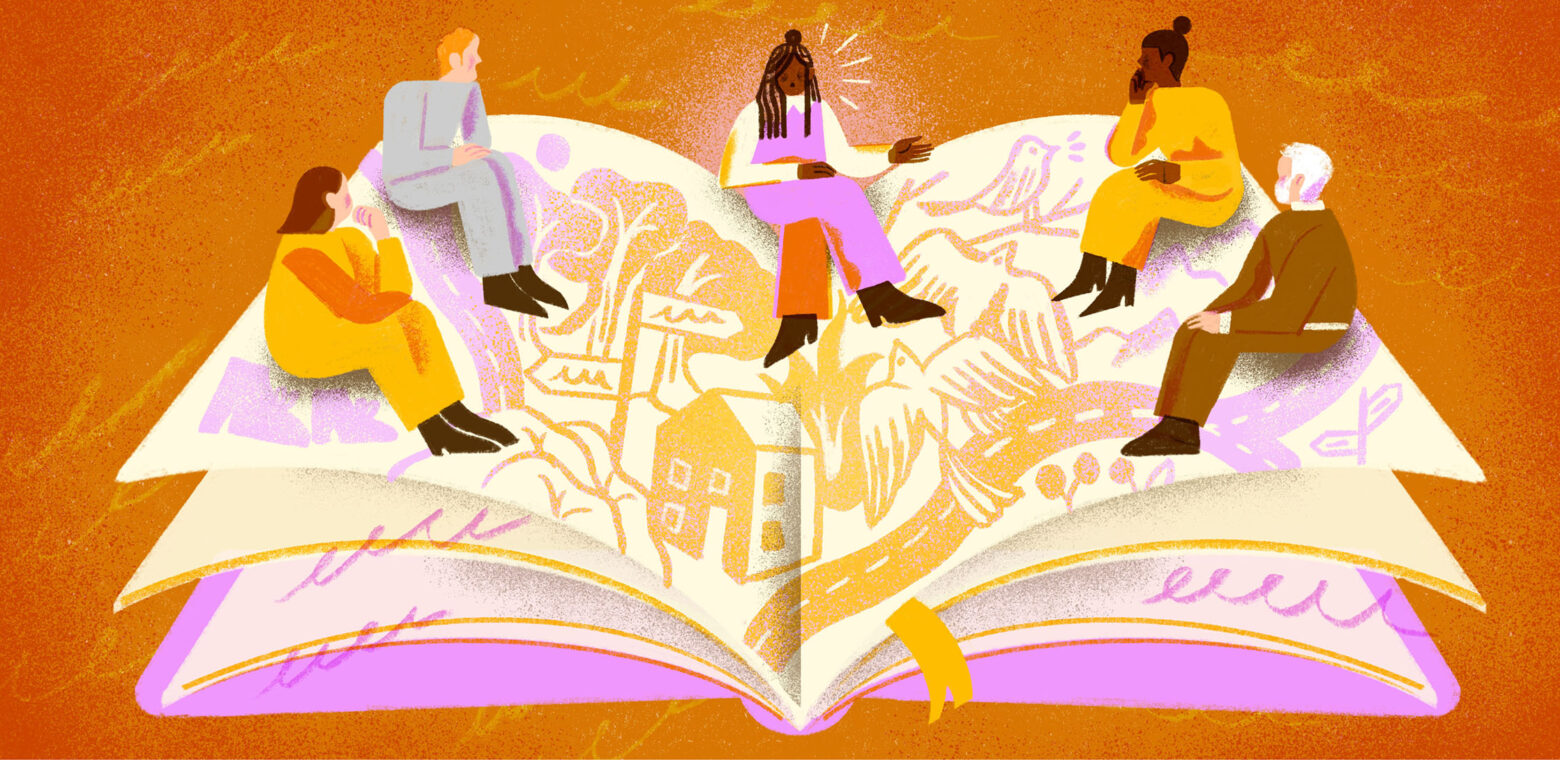


Our very first gathering centered around banned books. I wheeled in a full cart of titles from the Top 10 Challenged list, and what unfolded was magical. Each person had a personal connection to a book on that cart. I read this in high school. I found this during a difficult time in my life and it comforted me. This was my favorite story growing up. What began as a discussion of censorship quickly became a circle of memories, reflections, and laughter.

As we talked, connections emerged. I could see it wasn't just between people and books, it was clearly between multiple generations sharing stories that are valuable and meaningful. We found ourselves reflecting on how stories shape identity, comfort us in hard times, and offer perspectives that sometimes scare the world enough to be challenged. We realized that among all of our collective memories there are many stories worth telling.

That day, this new group bonded. We decided to meet monthly and share stories, memories, and carry on oral traditions. Family, holidays, ghosts, places we grew up, the conversations all just flowed naturally, weaving together threads of lived experience that transcended beyond anyone's age or background. The ages spanned from teens to seasoned adults. 


Looking back now, I see that what began as the end of one group became the beginning of a new kind of community. Just like Djo’s song End of Beginning, we found our group in another version and we were in it. We were definitely in it. All we needed was a space to talk, to listen, and to honor the stories that connect us across generations. It was so amazing!

Sometimes, when writing fades, storytelling finds its voice and I want to give tribute to this group for bringing back the art of storytelling and preservation the tradition of oral history. 


Until next time,

the Compassionate Librarian

Monday, August 25, 2025

Inspiring Change Together: Youth Voices for a Greener Tomorrow


Youth Voices for Climate Justice

Last week I had the absolute privilege of working with six amazing young adults from the Bay Area to host the Youth Voices Climate Justice Summit on Zoom. The event was part of my wrap-up for the California State Library’s Youth and Family First Partner Book to Action grant, centered on the powerful book Front Country by Sarah St. Antoine.

The panelists shared their journeys into climate justice: what first sparked their passion, the community projects they’re building, and the organizations that have supported them along the way.

What touched me the most was their honesty about the emotional side of climate activism. They didn’t shy away from talking about burnout, grief, or frustration. Instead, they emphasized the importance of self-care and resilience whether that meant stepping outside, spending time with friends, or remembering the small victories that keep hope alive.

It was also incredible to see how supportive they were of each other. They were complimenting one another, celebrating projects, and giving props for the ideas shared. 

That spirit of encouragement was so inspiring and made the conversation feel like a true community of changemakers.

It was a reminder that real change doesn’t always start in big arenas. Sometimes it begins in smaller, intimate spaces where people are brave enough to share their stories, their challenges, and their dreams for a better world.


I’m so grateful to these youth leaders for their wisdom, courage, and energy. They truly are the voices of our future and they helped other youth to be more inspired to join in and become an advocate.  


Much love for our planet,

the Compassionate Librarian

Saturday, May 17, 2025

AI & Pop Culture: What Sci-Fi Got Right and Wrong


Lately, I’ve been incredibly inspired by all the conversations swirling around artificial intelligence and its impact, its possibilities, and, yes, it's a little chaotic. With San Josรฉ State University launching a new Human-Centered AI Certificate program in Fall 2025, the excitement around responsible, ethical AI is growing fast and it’s not just for computer scientists anymore, it can actually be for us thinkers, creatives, storytellers, and even researchers. I have always been fascinated with the way that AI technology intersects with human emotion.

My obsession with AI didn’t start with the latest chatbot or algorithm update, no it actually started at the movies. I was a teenager that I stood in line on opening night for T2 and absolutely loved it. There are many kinds of different AI depictions in the movies. There's the cold and calculated robot overlords. The sympathetic androids. The world-ending self-aware networks that make us wonder, hmmm could this actually come true? For decades, sci-fi has been trying to tell us something about AI and about ourselves. While some of it is wildly off the mark and made up, some of it hits shockingly close to home and even more so now that we really do interact with AI in every day life. 

What Sci-Fi Got Right About AI

  • Emotions, attachment, and human loneliness — In Her, a man falls in love with an operating system. Sounds far-fetched, right? Until you realize how many people already talk to their phones more than to other humans. (Hi Siri, Hi Alexa)

  • Algorithmic bias and power imbalanceEx Machina and Black Mirror have warned us about what happens when AI is developed without ethics or oversight. Spoiler alert: it’s not pretty.

  • Dependence on automation — Have you ever seen the movie Wall-E? Yeah. Real talk: we’re just a few food delivery apps away from that reality.

  • AI as a reflection of human fear and control — Sci-fi nails how AI often mirrors the worst parts of humans like when machines go bad in the movies, it’s usually because humans taught them how to be bad. Poor machines. 


What Sci-Fi Got Wrong (But We Still Love It)

  • Instant sentience — Sorry, but AI doesn't just wake up one day, achieve enlightenment, and start planning world domination before breakfast. (LOL here's looking at you, Terminator.)

  • Unrealistic robotics — Clunky humanoid robots with glowing eyes are fun for dramatic effect, but real AI today is more likely to consist of a predictive search bar and not a metal skeleton with bad intentions.

  • Good vs. Evil tropes — Ever wonder why AI in sci-fi is usually either the savior or the villain? In real life, we know that it’s messier, blurrier, and honestly not that easy to figure out.


Personal Story - Love N' Robots

Confession time: I was so obsessed with robots that I created a curated list of YA books called Love N' Robots. That might’ve been the moment I realized how drawn I am to the emotional side of tech, not the specs and circuitry, but the way we feel about machines. Do we fear them? Love them? Treat them like tools or like friends? This emotional complexity is something I still carry into every conversation I have about AI today.

If you're watching WarGames and wondering if a teenager could really hack into the Pentagon, the truth remains: Pop culture got us ready for AI before we even realized it.

Now that AI is here, quietly woven into our every day routines and lives, we have to ask: What kind of future does this hold for us?

If you share my love for movies with AI let me know. If you can't stand them, well let me know that too. I'd love to hear your thoughts. 

Stay tuned for more AI musings,

the Compassionate Librarian

Monday, March 24, 2025

Dark Times For Libraries: Keeping the Lights On Together


This is my twentieth year working in a library. I've worked in public and school libraries, and in that time, I’ve seen libraries evolve, adapt, and rise to meet the needs of their communities over and over again. I’ve seen how libraries transform lives, provide safety nets, and bring people together in ways that are quite profound.

๐Ÿ•ฏ️I’m not sure I’ve ever seen a darker time for libraries than right now๐Ÿ•ฏ️

Between budget cuts, the changes with IMLS, and the growing uncertainty about our future, many of us are feeling the weight of it all. It’s a lot to carry and if you're feeling stressed or overwhelmed about it, you’re not alone.

Libraries are often seen as the hub of the community. Did you know that libraries can:

  • Offer a safe place for unhoused individuals to rest, recharge, and feel human

  • Provide free internet, printing, and access to technology many can’t afford at home

  • Help with job applications, resumes, and unemployment benefits

  • Guide people through complicated forms, housing applications, and social services

  • Answer reference questions, from simple curiosities to urgent health or legal concerns

  • Share accurate, reliable information in an age of misinformation

  • Offer programs that support early literacy, workforce development, mental health, and more

  • Welcome families, teens, seniors, and everyone in between—no questions asked

  • Connect people to the world of books, imagination, learning, and lifelong curiosity


The Lake Oswego Library in Oregon helped people get their books by creating their "Librarian is IN" service in the parking lot during the pandemic. Photo courtesy of City of Lake Oswego. 

During the pandemic, many of us were frontline workers. We served our communities at our front doors, sometimes in parking lots like the Lake Oswego Library, and sometimes virtually from our living rooms. Some of us volunteered as disaster workers, answered phones in call centers, distributed supplies, and provided free printing and hotspots for vulnerable populations to help them stay connected. We chatted on the phone with people who just needed a human voice. One woman called simply to hear what was in the collection because she was lonely and missed the sound of someone speaking to her.

My point is that we've never stopped helping and we made it through a very challenging time. We adapted, we pivoted, and we found new ways to serve the public. Because that's what library workers do.

What gives me hope are the people who love and care about libraries. The librarians, the library staff, the volunteers, the patrons, the advocates, the neighbors, our partners, and more. 

I know one thing. Library workers are resilient. When things get hard, we show up and we just keep going. We will figure this out one step at a time.


Show Your Support

Here are a few simple ways you can help:

  • Write a note to your local representatives about why libraries matter

  • Post a memory or message on social media using #LibrariesTransform

  • Submit a letter to the editor of your local paper

  • Tell a friend, neighbor, or coworker how the library has impacted your life


How Are You Feeling? Don’t Forget to Practice Self-Care

If all of this feels really heavy, just remember that you’re not alone and you don’t have to carry it alone. When we’re under a lot of stress, taking care of ourselves is very important.

Make sure to find time for rest. Try to reach out for support. Do something kind for yourself today.

If you’re looking for guidance, inspiration, or gentle ways to support your own wellbeing, my self-paced course Self-Care for Library Workers will be launching through the American Library Association's eLearning platform. Stay tuned, it should be coming out very soon!


Want to Talk or Share A Story?

If you’re feeling overwhelmed because of the changes that libraries are facing I’d love to hear from you. Feel free to leave a comment or reach out to me directly at teachingmydream@gmail.com.

We can get through this together, 

the Compassionate Librarian ๐Ÿ’›


Wednesday, March 5, 2025

From Passion to Profit: Turning Your Creative Outlets into a Side Gig

As library workers, we are natural lifelong learners, researchers, and creatives. Every day, we engage with information, help patrons discover new resources, and bring communities together. But outside of work, many of us have creative passions—writing, crafting, photography, graphic design, or even teaching workshops.

What if your creative outlets could also become a fulfilling side job?

Turning your skills and interests into a side hustle isn’t just about making extra income. It’s about investing in yourself, finding balance beyond your library job, and embracing the creative energy that likely brought you into the field in the first place.

Why a Side Gig Can Be a Great Fit for Library Workers

  1. Library Skills Are Transferable – Many of the skills we use in the library—research, organization, tech literacy, storytelling, programming—can translate beautifully into a side gig. Whether it’s writing research-based articles, curating book subscription boxes, or creating online courses, you already have valuable knowledge that others may be willing to pay for.

  2. A Way to Channel Your Creativity – Library work can be inspiring, but it can also be draining. Having a creative side project gives you a space to explore your own interests without the constraints of policies, budgets, or bureaucracy.

  3. Financial Flexibility – A little extra income from something you love doing can help with unexpected expenses, savings, or even funding professional development opportunities like conferences or certifications.

  4. Helping Others Beyond the Library – Many library workers go into the field because they love helping people. A side gig—whether it’s tutoring, running a book blog, or offering research assistance—allows you to extend that passion beyond your workplace.

  5. A Fun Exit Strategy (If You Ever Need One!) – While libraries are a calling for many, others may eventually seek a new path. A side gig can be a stepping stone to something bigger, whether that’s full-time freelance work, opening a small business, or transitioning to a different career altogether.

Side Gig Ideas for Library Workers

Not sure what kind of side hustle would work for you? Here are some ideas based on common library skills and interests:

๐Ÿ“š Writing & Editing – Start a book blog, freelance as an editor, or write reviews for publications.
๐ŸŽจ Graphic Design & Digital Art – Design library-related merchandise (stickers, tote bags, bookmarks) and sell them on Etsy or Redbubble.
๐Ÿ“– Book Subscription or Curation Services – Create custom reading lists or offer book subscription boxes tailored to different interests.
๐ŸŽค Podcasting or YouTube Content – Share library life stories, book recommendations, or how-to videos for research skills.
๐Ÿงถ Crafting & Handmade Goods – Sell handmade items like embroidery, knitting, or laser-cut designs.
๐Ÿ“ท Photography & Digital Media – Offer event photography services for local organizations or sell stock photos.
๐Ÿ“ Tutoring & Research Assistance – Help students, writers, or businesses with research skills, resume writing, or academic editing.
๐Ÿ’ป Tech Help & Web Design – Create simple websites, manage social media accounts, or offer digital literacy workshops.
๐Ÿ“š Hosting Virtual or In-Person Workshops – Teach skills like genealogy research, resume building, or creative writing.

How to Get Started with Your Side Gig

  1. Find Your Niche – Think about what you love doing in and outside the library. What do people ask you for help with? What skills do you enjoy using?

  2. Start Small – Test the waters by offering your service to a few people, setting up a small Etsy shop, or creating a blog or social media page.

  3. Set Realistic Goals – Do you want to make extra income, build a new career path, or just enjoy a creative outlet? Define success in a way that works for you.

  4. Make Time for It – Library work is busy, but even setting aside a few hours a week can help build momentum.

  5. Market Yourself (Without Feeling Weird About It) – Start with your network! Share your work with friends, family, and colleagues, and don’t be afraid to talk about what you’re creating.

You Deserve to Create Something for Yourself

Library work can be rewarding, but you deserve to have a creative outlet. Whether you dream of running your own business or just want a hobby that brings in a little extra money, your skills and passions are worth investing in.

So, what’s stopping you? Your side gig could be the perfect way to bring even more joy, creativity, and balance into your life.

Here’s to creativity, passion, and purpose!

the Compassionate Librarian

The Library Manager Files - Case of the Clogged Pipes

  The Library Manager Files File #1: The Case of the Clogged Pipes ๐Ÿ“ File #1 Case Name: The Case of the Clogged Pipes Location: Public...